Technical Analysis and Application of High-Pressure Steel Wire Wound Rubber Hose SAE100R9
Technical Analysis and Application of High-Pressure Steel Wire Wound Rubber Hose SAE100R9
In modern industrial hydraulic systems, high-pressure hoses are crucial components for energy transmission, and their performance directly impacts the safety and reliability of the entire system. The SAE100R9 1-inch four-layer steel wire spiral wound rubber hose, with its 380 bar working pressure capability, is an ideal choice for engineering machinery, mining equipment, and oil drilling. This article will delve into the technical features, manufacturing process, and typical application scenarios of this product.
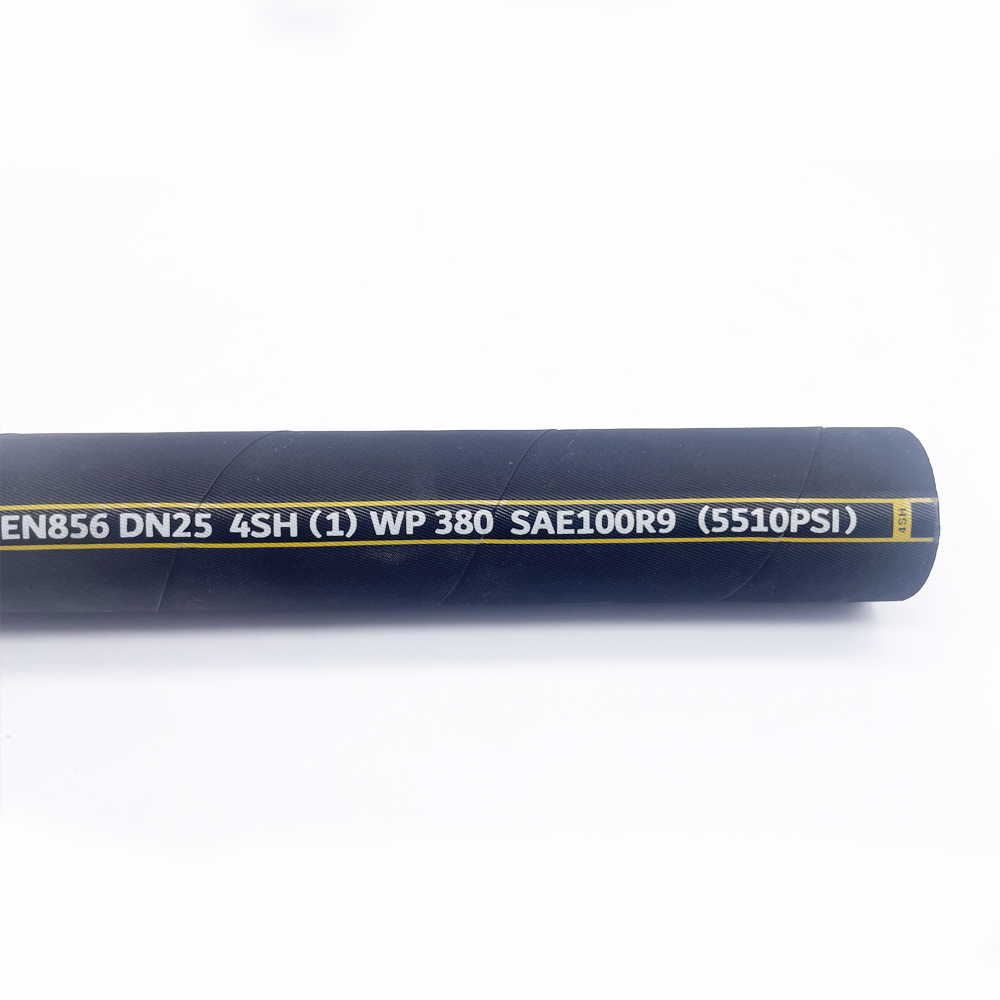
I. Structural Design and Material Innovation This hose employs a four-layer high-strength steel wire spiral wound structure, with each layer of wires arranged in a staggered, balanced angle of 54°~55°. This design ensures uniform stress distribution under high pressure. The inner rubber layer uses nitrile rubber (NBR) with excellent oil resistance and an acrylonitrile content of over 34%, making it resistant to petroleum-based hydraulic oils, bio-oils, and water-glycol media. The intermediate reinforcing layer uses 0.3mm diameter copper-plated high-carbon steel wire (tensile strength ≥2160MPa), while the outer layer is wrapped with weather-resistant neoprene rubber (CR), effectively resisting ultraviolet radiation, ozone, and external abrasion.
II. Breakthrough Performance Parameters
- Pressure Characteristics: Under standard conditions of 23℃, the working pressure reaches 380 bar (approximately 38 MPa), and the burst pressure can reach 4 times the working pressure. Dynamic pulse testing shows that it can withstand more than 2 million pulse cycles at 2.5 times the working pressure.
- Temperature Adaptability: Operating temperature range of -40℃ to +100℃, with short-term peak temperatures reaching +120℃. Successful applications have been reported in Arctic oil fields and equatorial mines.
- Bending Radius: The minimum bending radius of the 1-inch specification is only 254mm, approximately 15% less than similar products, greatly improving equipment layout flexibility.
III. Precision Manufacturing Process
The production process utilizes PLC-controlled winding equipment imported from Germany, controlling the wire tension error within ±1.5N. The vulcanization process employs segmented gradient heating technology, achieving a vulcanization degree of over 92%. Each hose undergoes 25 tests, including: – 3D industrial CT scanning to check wire arrangement density – Helium mass spectrometry leak detector to test sealing performance – 2000Hz high-frequency vibration fatigue test. For special operating conditions, a conductive design is also available, with an electrostatic discharge value <10^6Ω, meeting the requirements for use in flammable and explosive environments.
IV. Typical Application Scenarios Comparison 1. Construction Machinery: In the hydraulic system of a 35-ton excavator, it reduces weight by up to 60% compared to traditional steel pipes, while reducing hydraulic impact noise by 15 decibels. After adopting this design on a certain brand of rotary drilling rig, the failure rate of the main winch motor hose decreased by 73%. 2. Oil Drilling Applications: In the top drive unit of a 7000-meter deep well, its hydrogen sulfide resistance performance exceeds the API 16D standard requirements, maintaining stability even under conditions with H2S concentrations up to 500ppm. 3. Metallurgical Industry: In the hydraulic system of continuous casting machines, under the radiant heat of molten steel, its service life is 2.8 times longer than that of ordinary hoses.
V. Maintenance and Selection Recommendations It is recommended to perform a visual inspection every 500 working hours, focusing on: – Whether the outer rubber layer is cracked (crack depth > 1mm requires replacement) – Whether there are oil leaks at the joints – Whether the steel wire layer is exposed When storing, the coiled diameter should be no less than 15 times the outer diameter of the hose, avoiding folding. When selecting a hose, pay attention to: – For pulsed conditions, select a safety factor of at least 1.5 times the working pressure. – When using abrasive media, a spring sheath should be installed. – For low-temperature environments, a cold-resistant rubber compound should be specified.
VI. Technological Development Trends The newly developed nano-clay modified rubber compound has entered the testing phase. Laboratory data shows that it can improve oil resistance by 40%. Smart hose technology is under testing, using built-in fiber optic sensors to monitor pressure fluctuations and fatigue status in real time. In terms of environmental protection, the bio-based rubber compound has passed RoHS 2.0 certification, with a biodegradability rate of over 85%.
This SAE100R9 hose, with its superior performance, is redefining the standard for high-pressure fluid transmission. With the advancement of the Made in China 2025 strategy, the market share of domestically produced high-end hydraulic hoses has increased from 32% in 2018 to 67% today, gradually breaking the monopoly of foreign brands in the ultra-high pressure field. In the next three years, with the integration of 5G and industrial internet technologies, intelligent diagnostic hoses will become the new industry standard.
Previous: High-Temperature Steam Hoses: A Comprehensive Overview No more, this is the last articleCategories
Recent Posts
- Analyse technique et application du tuyau en caoutchouc enroulé de fil d’acier haute pression SAE100R9
- Technical Analysis and Application of High-Pressure Steel Wire Wound Rubber Hose SAE100R9
- High-Temperature Steam Hoses: A Comprehensive Overview
- High-Temperature Steam Hoses: A Comprehensive Overview
- Steel wire spiral reinforced hose
Contact
- Name : John wang
- Position : Sales Manager
- Email : [email protected]
- Phone : (+86)16650911696
- whatsApp : +86 16650911696